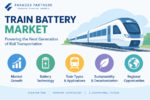
Faradex Partners presents its latest analysis of the global Train Battery Market, providing insights into industry developments, emerging technologies, competitive dynamics, and future growth opportunities. The study examines the increasing adoption of battery-electric and battery-hybrid trains, evolving railway infrastructure requirements, and the factors shaping demand for advanced onboard energy storage systems. The report supports railway operators, manufacturers, investors, and industry stakeholders in understanding market trends and evaluating potential business opportunities.
The global Train Battery Market was valued at USD 1.28 billion in 2025 and is projected to reach USD 4.65 billion by 2035, registering a compound annual growth rate (CAGR) of 13.8% from 2026 to 2035. Market expansion is supported by railway modernization initiatives, growing demand for lower-emission transportation, and increasing investments in battery-powered rolling stock.
Market Overview and Key Growth Drivers
The Train Battery Market is gaining momentum as railway operators explore alternatives to conventional diesel-powered trains. Battery-electric and battery-hybrid technologies provide a practical solution for regional and branch railway lines where installing complete overhead electrification infrastructure may be expensive or difficult to implement.
These trains use onboard battery systems to operate on non-electrified sections while allowing recharging on electrified routes or at designated charging points, depending on the train configuration. This flexibility enables operators to reduce diesel dependence without requiring extensive infrastructure changes across entire railway networks.
An important industry development occurred in April 2025, when Hitachi Rail secured an order from Arriva Group for nine tri-mode battery-hybrid trains comprising 45 rail cars. The investment was valued at approximately GBP 300 million, including a 10-year maintenance contract. The trains can operate using overhead electricity, battery power, or diesel, highlighting the growing importance of flexible rolling stock solutions.
Explore the Complete Train Battery Market Report
Businesses and investors can explore market forecasts, battery technology developments, regional opportunities, competitive positioning, and strategic industry developments through the dedicated Faradex Partners report.
The Train Battery Market is segmented by train type, battery chemistry, application, and region. These categories help explain how railway operating requirements and technological developments influence demand for different battery systems.
By train type, the market includes battery-electric multiple units (BEMUs), battery-hybrid or tri-mode trains, and battery-electric locomotives and shunters. Battery-electric multiple units represent the leading segment because they can replace conventional diesel multiple units on regional and commuter routes with partial electrification.
Battery-hybrid and tri-mode trains are also gaining attention because they can operate across different infrastructure conditions. Their ability to use overhead electricity, onboard batteries, or diesel provides flexibility for railway operators managing mixed networks.
Battery chemistry is another important consideration. Nickel manganese cobalt (NMC), lithium iron phosphate (LFP), and lithium titanate (LTO) technologies serve different performance requirements. Factors such as energy density, charging speed, cycle life, safety, and operating costs influence the suitability of each chemistry for particular railway applications.
Competitive Landscape and Industry Developments
Competition in the Train Battery Market is influenced by technological innovation, rolling stock procurement, battery performance, and the ability to meet railway safety and durability requirements. Manufacturers and suppliers are focusing on solutions that improve operational reliability, charging efficiency, and long-term battery performance.
Key companies and industry participants include Hitachi Rail, Alstom, Stadler Rail, Škoda Group, CRRC, Siemens Mobility, CAF, and Newag. These companies participate in the development or supply of battery-electric and battery-hybrid railway platforms.
In July 2026, Škoda Group disclosed that it had secured orders for more than 100 battery-powered trains in connection with its 2025 financial results. This development highlights the expanding interest in battery-powered rolling stock among railway manufacturers and operators.
In February 2026, Lithuania's LTG Link began testing battery-electric trains manufactured by Stadler Rail ahead of planned commercial service later that year. Such programmes demonstrate the continuing development of battery-powered railway transportation across Europe.
Regional Outlook and Growth Opportunities
Europe accounted for the largest regional revenue share of the Train Battery Market in 2025. Demand is supported by railway fleet renewal, decarbonization targets, and investment in battery-electric and hybrid rolling stock. The United Kingdom, Italy, Germany, Ireland, and Lithuania are among the markets experiencing developments involving battery-powered trains.
Asia Pacific is expected to experience rapid growth as railway operators and manufacturers explore battery-electric and hybrid solutions for regional, commuter, and shunting applications. China has an established railway manufacturing base, while Japan contributes through battery train development. India and South Korea also present potential opportunities as operators evaluate alternatives for selected non-electrified routes.
North America is another developing market, supported by commuter rail modernization and zero-emission transportation initiatives. Battery-electric train programmes and procurement activities are creating opportunities for manufacturers and battery technology suppliers.
Meanwhile, Latin America and the Middle East and Africa represent emerging opportunities, although adoption may remain comparatively limited in the near term because of infrastructure constraints and differences in railway investment priorities.
Market Challenges and Future Prospects
Despite its growth potential, the Train Battery Market faces several challenges. Operating range remains an important consideration, as battery-electric trains generally require suitable charging opportunities for longer or fully non-electrified routes. Railway batteries must also withstand vibration, demanding operating conditions, and extended service requirements while meeting stringent safety standards.
High procurement costs, battery degradation, replacement planning, and fluctuations in raw material prices can influence investment decisions. Additionally, railway purchasing cycles are often lengthy, creating variations in order volumes and demand for battery suppliers.
However, continued improvements in battery chemistry, charging systems, and energy management are expected to support further market development. As operators seek to modernize railway fleets and reduce dependence on diesel, battery-electric and hybrid trains are positioned to play an increasingly important role in regional rail transportation.
Access Market Intelligence from Faradex Partners
The Faradex Partners Train Battery Market report examines market size, revenue forecasts, segmentation, regional developments, indicative pricing trends, strategic developments, and competitive positioning. These insights can help businesses assess emerging opportunities, understand supplier activity, and support investment and procurement decisions.
Visit Faradex Partners for Market Research Reports, Industry Analysis, and Battery Market Intelligence:https://www.faradexpartners.com/
Customized Research and Business Insights
Organizations with specific research requirements can explore customized research solutions to investigate selected market segments, regional demand, battery technologies, competitor strategies, and industry developments. Tailored market intelligence can support market-entry planning, investment evaluation, supplier assessment, and long-term business strategy.
In conclusion, the global Train Battery Market is evolving alongside railway modernization, demand for lower-emission transportation, and the adoption of battery-electric and hybrid rolling stock. Although infrastructure requirements, operating range, and battery lifecycle considerations remain important challenges, continued technological development is creating opportunities for manufacturers, suppliers, railway operators, and investors. Faradex Partners provides market-focused research to help industry stakeholders understand these developments and make informed strategic decisions.
About Faradex Partners
Faradex Partners provides battery market intelligence and industry research covering battery technologies, manufacturing, materials, supply chains, and related market developments. Its research supports strategy teams, procurement professionals, and investors seeking insights into market conditions, competitive activity, and commercial opportunities across the battery sector.